OpenStation
wp-admin forgets. OpenStation doesn’t. You know the moment. You’re deep in a post and you need one image from the Media Library. You click over, find it, click back, and everything you had going is gone. Your scroll position, your half-typed thought, the three other things you had queued up in your head. That’s not a bug you hit. That’s the design. wp-admin shows you one screen at a time, and every navigation throws the last one away. It has worked this way since 2003, like a fridge that empties itself every time you close the door. WordPress has rebuilt almost everything else. The editor, the site editor, the patterns, the styles. The admin’s one-screen-at-a-time model is the layer nobody touched. OpenStation touches it. Install it and admin screens become draggable, resizable windows. Edit a post while the Media Library sits open next to it. Drag an image from one window straight into the other. Keep comments open in the corner. Reload the browser and your window layout — open pages, positions, sizes, and window states — comes back where you left it. OpenStation itself is free, GPL, and opt-in per user. One click in the admin bar turns it on for you. One click turns it off. Nobody else on your site sees anything change, and deactivating the plugin restores the classic admin exactly. No Core patches and no lock-in. Optional AI providers may charge for their service. Built and maintained by Automattic, the company behind WordPress.com, Jetpack, WooCommerce, and Tumblr. Work on more than one thing at once Admin pages open as windows, including pages added by most other plugins. Drag them, resize them, snap them, tile them, minimize them to a taskbar. The admin menu becomes a dock of icons. Two editors open at once is one click away. Never lose your place Moving between open windows leaves each page in place. Across reloads, OpenStation remembers your open pages, window positions, sizes and states, virtual desktops, and focus. Closing a window with unsaved changes warns you first. A desk you can actually put things on Drop posts, media, and links right onto the wallpaper. Sort them into folders. Trash them to a Trash that actually holds things. The stuff you’re working on this week can just sit out where you can see it. One desktop per job Virtual desktops, the way your operating system does them. One for writing. One for the store. One for comment triage. One for that redesign you keep poking at. Switch between them without closing anything. Find anything with Cmd+K The full WordPress command palette, plus slash commands from your plugins, all under one keystroke. Turn on the optional AI assistant and you can ask it things like “which post had the comment asking for the recipe?” and it searches your own content to answer. (Requires an AI provider configured in Settings → Connectors on WordPress 7.0+. Details under “External services” below.) See how your site fits together The Corkboard is an interactive, zoomable map of how your posts, pages, and products link to each other. Pan around it. Find the orphans. Find the hubs. Running a store? Orders, Products, Coupons, and Customers become browsable folders with stock and sale ribbons. Open a customer to see their lifetime spend and what they buy most. Follow a product to its buyers, or a coupon to who redeemed it. Make it yours Wallpapers, from color presets to animated scenes to your own photo. Live widgets pinned to the desktop: drafts, stats, recent comments, a focus timer. Uploadable desktop themes, including a built-in Legacy theme that brings the old WordPress blue back in one click. And Mio, a soft-body desk companion that drifts across your wallpaper and gets bumped around by your windows. Off by default. You’ll turn it on. For developers Extend OpenStation through documented PHP and JavaScript APIs. Register windows, icons, wallpapers, widgets, commands, and settings tabs through stable openstation_register_* PHP APIs and a typed JavaScript API; customize dock items through documented hooks; add AI tools with the WordPress Abilities API. Copy-paste examples live in the developer docs on GitHub. External services No external service is required for OpenStation’s desktop interface. The optional AI Assistant and two user-initiated enrichment features make the external requests described below. AI Assistant The optional AI Assistant sends data to the AI provider you configure in WordPress’s Settings → Connectors (for example OpenAI, Anthropic, or Google). Generation is routed through WordPress 7.0’s built-in AI Client, which supplies the credentials stored in Connectors. The plugin never handles an API key itself. With no provider configured in Connectors, no external AI requests are made. When the AI Assistant is enabled and a user invokes it (via Cmd+K or the slash-command palette): What is sent: the user’s prompt, the conversation history for the active session, and tool-call metadata. The plugin’s built-in tools (search_posts, search_pages, search_comments) run WordPress’s native keyword search and may include excerpts of the matching posts/pages/comments in tool results, which are then sent back to the provider as part of the agentic loop. When it is sent: on user-initiated AI requests, and (if an administrator enables “Score new comments with AI”) on comment-save hooks for spam analysis. Posts, pages, and taxonomy terms are not sent automatically. Why it is sent: to obtain model completions and tool-call decisions that drive the AI Assistant. Who provides the service: whichever provider you configured in Settings → Connectors. Which provider (and endpoint) receives the data depends entirely on that configuration. Review the chosen provider’s own terms and privacy policy (e.g. OpenAI, Anthropic, or Google). URL shortcut favicons When an authorized user creates a desktop shortcut to an external URL, OpenStation asks that URL for its page HTML and favicon so the shortcut can display the site’s icon. The request is made from your WordPress server and sends the requested URL, the server’s IP address, an OpenStation user-agent string, and normal HTTP request metadata to the operator of that site. This happens only when a user creates the shortcut. The destination site’s terms and privacy policy apply. WordPress.org plugin information When an authorized user opens or refreshes parts of OpenStation’s Plugins window, OpenStation may request public plugin details, update metadata, and review excerpts from WordPress.org. These requests send plugin slugs, the site’s locale, and normal HTTP request metadata to WordPress.org. This information is used only to display and manage plugins. Review the WordPress.org Privacy Policy. OpenStation’s OAuth relay does not contact a service by itself. Third-party plugins that configure the relay may contact their own providers and are responsible for disclosing those services. Credits OpenStation is brought to you by Automattic. The plugin is open source under GPLv2-or-later; contributions are welcome on GitHub. Third-party libraries The plugin bundles the following third-party JavaScript library, loaded on demand only when a feature that needs it is in use: PixiJS (MIT License) — used by the Corkboard window, built-in canvas wallpapers (e.g. the animated WordPress logo), the Mio desk companion, and the Inkfall typing game. PixiJS is loaded from the plugin’s own assets/vendor/ directory; no CDN requests are made. Data files The Inkfall game’s word list (assets/games/inkfall/words.txt) is generated from the following sources (attribution also ships in the file’s header): FrequencyWords by Hermit Dave (CC-BY-SA 4.0) — English word-frequency ranking derived from the OpenSubtitles corpus. english-words by dwyl (Unlicense) — used as a validity filter. LDNOOBW English list (CC-BY 4.0) — used as an exclusion filter.
Top keywords
- wordpress15×1.17%
- ai14×1.10%
- openstation13×1.02%
- open9×0.70%
- pages8×0.63%
- provider7×0.55%
- site7×0.55%
- window7×0.55%
- admin6×0.47%
- ai assistant6×0.47%
- assistant6×0.47%
- click6×0.47%
WBD Pricing Tables – Gutenberg Pricing Table & Comparison Block
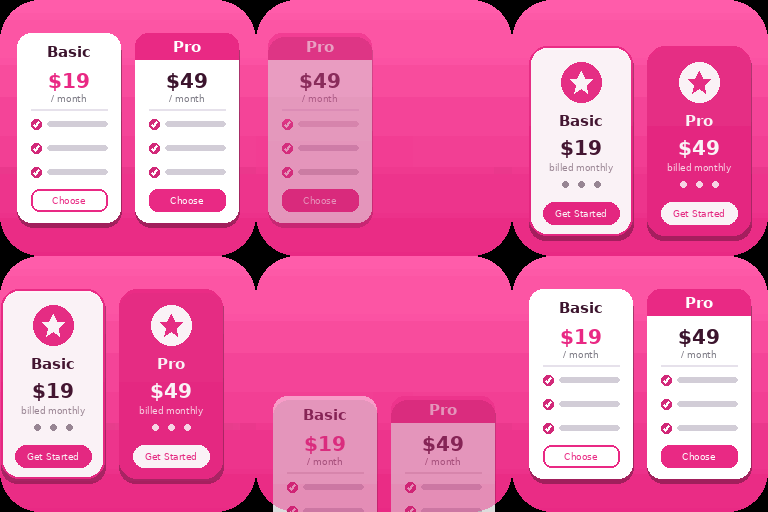
Pricing Tables Block for Gutenberg is a powerful and easy-to-use WordPress pricing table plugin that helps you create stunning pricing tables, pricing comparison tables, and pricing plans layouts directly inside the block editor. Live Demos | Pricing | Support Whether you’re building SaaS pricing pages, product comparison tables, or service plans — this Gutenberg pricing table block gives you full control without any coding.Lightweight, fast, and fully responsive — works with every WordPress theme. 🚀 Perfect for freelancers, agencies, SaaS, startups, and WooCommerce websites. Features ✅ Free Features Free Templates – Add up to 3 pricing plans displayed side by side in a responsive grid. Customizable Plan Details — Set plan name, price, currency symbol, billing period, and description for each plan. Feature Lists — Add unlimited features per plan with optional checkmark or cross icons to indicate included/excluded features. Call-to-Action Buttons — Customize button text and URL for each plan with option to open links in a new tab. Featured/Recommended Plan — Highlight a plan as “recommended” with a badge and visual emphasis. Color Customization — Choose header background color, header text color, button color, button text color, and featured plan accent color. Layout Options — Choose between 1 to 4 columns layout. Responsive Design — Plans stack gracefully on smaller screens. Live Preview — See all changes in real time within the editor. ⚡ Pro Version Features If you need even more features, styling options, or premium support, you can upgrade to the Pro version: Five Premium Templates Comparison pricing table block Advanced Styling & Layout Controls Priority Support — Dedicated help within 24 hours Why Choose This Pricing Table Block Plugin? Built specifically for Gutenberg (Block Editor) Lightweight and fast loading (better SEO performance) Fully responsive pricing table design No shortcode required – 100% block-based Clean UI inspired by modern SaaS pricing tables Use Cases SaaS pricing pages Service pricing plans Product comparison tables Subscription plans Agency packages SEO-Friendly Pricing Sections WBD Pricing Tables helps you create structured and readable pricing sections using the WordPress Block Editor. The plugin focuses on: Clean frontend markup. Responsive layouts. Lightweight implementation. Accessible interactive elements where applicable. Mobile-friendly pricing sections. Clear pricing and feature presentation. The plugin does not replace an SEO plugin. Search engine rankings depend on your overall website content, technical SEO, performance, competition, backlinks, and other factors. Development The uncompiled source code for this plugin is fully open-source and publicly accessible. Source Code Repository: https://github.com/wpbranddigital/wbd-pricing-table Source Folder: The human-readable and modifiable source files are included in the /src directory of the plugin. Build tools and environment: – Node.js & npm – webpack – @wordpress/scripts To regenerate the compiled files from source: 1. Clone the repository or navigate to the plugin directory. 2. Run npm install to install dependencies. 3. Run npm run build to compile the production assets into the /build directory. 4. Run npm run start to start the development watcher.