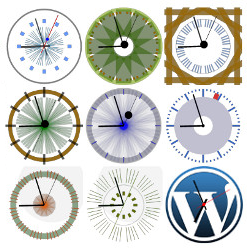
CoolClock – a Javascript Analog Clock
This plugin integrates CoolClock – The Javascript Analog Clock into your WordPress site. You can add it as a widget to your sidebar or insert it into your posts and pages with a shortcode. See the FAQ’s for available shortcode parameters and how to build the clock into your theme. Features Can be added via a widget, shortcode or theme function No flash, meaning compatible with tablets and most other javascript enabled mobile devices 22 different skins to choose from or Custom skin option to create your own skin style Linear or logarithmic time scale Read more on the CoolClock homepage or see the FAQ’s to learn how to configure your own skin settings. Pro features Show date or 24h digital time Background image or color Border radius (rounded corners for background) Advanced positioning options (relative to background) Advanced shortcode parameters (including background image and custom skin) One extra clean skin for use with background image Support on the CoolClock Pro forum Pro features come with the CoolClock – Advanced extension. Translators Dutch * R.A. van Hagen https://status301.net/ (version 3.0) French * R.A. van Hagen https://status301.net/ (version 3.0) German * Manfred Mrak http://www.niftyfox.ch/ (version 3.2) Serbian * Borisa Djuraskovic – WebHostingHub http://www.webhostinghub.com/ (version 2.9.4) Slovenian * Adijan Dervišević – http://www.adijan.eu (version 3.2) Russian * Наталия Завьялова – http://time-impressions.ru (version 2.9.8) Please contact me to submit your translation and get mentioned here 🙂 Privacy / GDPR This plugin does not collect any user or visitor data nor set browser cookies. Using this plugin should not impact your site privacy policy in any way. Known Issues When IE 8 is manually put or forced (through X-UA-Compatibility meta tag or response header) into Compatibility mode, the Clock will –even though the canvas area is put in place– remain invisible. When a shortcode is not placed on its own line but on the same line with text, image or even another shortcode, then the output (div with canvas tag) will be wrapped inside a paragraph tag. While most browsers do not have a problem displaying the clock, this will cause a validation error. Please report any other issues on the Support page.
Top keywords
- shortcode6×1.62%
- version6×1.62%
- background5×1.35%
- skin5×1.35%
- clock4×1.08%
- coolclock4×1.08%
- http4×1.08%
- image4×1.08%
- advanced3×0.81%
- background image3×0.81%
- http www3×0.81%
- own3×0.81%
Image Widget
Image Widget is a simple plugin that uses the native WordPress media manager to add image widgets to your site. Image Widget Features Responsive MU Compatible Handles image resizing and alignment Link the image Add title and description Versatile – all fields are optional Upload, link to external image, or select an image from your media collection Customize the look & feel with filter hooks or theme overrides Quality You Can Trust Image Widget is developed and maintained by The Events Calendar, the same folks behind The Events Calendar, Event Tickets, and a full suite of premium plugins. This plugin is actively supported by our team and contributions from community members. If you see a question in the forum you can help with or have a great idea and want to code it up or submit a patch, that would be awesome! Not only will we shower you with praise and thanks, it’s also a good way to get to know us and lead into options for paid work if you freelance. Pull Requests & Translations Check us out on GitHub to pull request changes. Translations can be submitted here on WordPress.org. Documentation The built in template can be overridden by files within your template. Default vs. Custom Templates The Image Widget comes with a default template for the widget output. If you would like to alter the widget display code, create a new folder called “image-widget” in your template directory and copy over the “views/widget.php” file. Edit the new file to your hearts content. Please do not edit the one in the plugin folder as that will cause conflicts when you update the plugin to the latest release. New in 3.2: You may now also use the “sp_template_image-widget_widget.php” filter to override the default template behavior for .php template files. Eg: if you wanted widget.php to reside in a folder called my-custom-templates/ and wanted it to be called my-custom-name.php: add_filter('sp_template_image-widget_widget.php', 'my_template_filter'); function my_template_filter($template) { return get_template_directory() . '/my-custom-templates/my-custom-name.php'; } Filters There are a number of filters in the code that will allow you to override data as you see fit. The best way to learn what filters are available is always by simply searching the code for ‘apply_filters’. But all the same, here are a few of the more essential filters: widget_title This is actually a pretty typical filter in widgets and is applied to the widget title. widget_text Another very typical widget filter that is applied to the description body text. This filter also takes 2 additional arguments for $args and $instance so that you can learn more about the specific widget instance in the process of filtering the content. image_widget_image_attachment_id Filters the attachment id of the image. Accepts additional $args and $instance arguments. image_widget_image_url Filters the url of the image displayed in the widget. Accepts additional $args and $instance arguments. THIS IS DEPRECATED AND WILL EVENTUALLY BE DELETED image_widget_image_width Filters the display width of the image. Accepts additional $args and $instance arguments. image_widget_image_height Filters the display height of the image. Accepts additional $args and $instance arguments. image_widget_image_maxwidth Filters the inline max-width style of the image. Hint: override this to use this in responsive designs 🙂 Accepts additional $args and $instance arguments. Return null to remove this css from the image output (defaults to ‘100%’). image_widget_image_maxheight Filters the inline max-height style of the image. Accepts additional $args and $instance arguments. Return null to remove this css from the image output (defaults to null) image_widget_image_size Filters the selected image ‘size’ corresponding to WordPress registered sizes. If this is set to ‘tribe_image_widget_custom’ then the width and height are used instead. Accepts additional $args and $instance arguments. image_widget_image_align Filters the display alignment of the image. Accepts additional $args and $instance arguments. image_widget_image_alt Filters the alt text of the image. Accepts additional $args and $instance arguments. image_widget_image_link Filters the url that the image links to. Accepts additional $args and $instance arguments. image_widget_image_link_target Filters the link target of the image link. Accepts additional $args and $instance arguments. image_widget_image_attributes Filters a list of image attributes used in the image output. Similar to ‘wp_get_attachment_image_attributes’ Accepts $instance arguments image_widget_link_attributes Filters a list of attributes used in the image link. Similar to ‘wp_get_attachment_image_attributes’ Accepts $instance arguments Have You Supported the Image Widget? If so, then THANK YOU! Also, feel free to add this line to your wp-config.php file to prevent the image widget from displaying a message after upgrades. define( ‘I_HAVE_SUPPORTED_THE_IMAGE_WIDGET’, true ); For more info on the philosophy here, check out our blog post