Autocomplete Address and Location Picker for WooCommerce
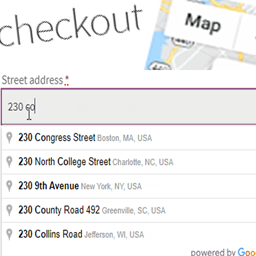
Developed by PowerfulWP This plugin integrates Google Places Autocomplete into your WooCommerce checkout, enabling customers to quickly and accurately fill in their billing and shipping addresses. This drastically improves checkout speed, enhances data accuracy, and reduces delivery failures caused by typos. It is the perfect solution for WooCommerce address validation and improving the customer experience. 💎 Get Premium | 📚 Documentation 🛑 Critical API Notice & Version Comparison The Premium Version is essential for all new users and businesses focused on accurate geocoding and delivery management. ⚠️ Google API Change Google has officially deprecated the Legacy Places API for all new Google Cloud projects. ➡️ If your Google Maps project was created recently, the legacy API cannot be enabled. You must upgrade to Premium to use the New Google Places API (PlaceAutocompleteElement), which is required for address autocomplete to function correctly. 🆓 Free Features (Classic Checkout Only) The free version provides essential address autocomplete functionality for the Classic WooCommerce Checkout using the Legacy Google Places API. Autocomplete Address: Automatically suggests and fills billing and shipping addresses using the Google Places API (Legacy). Maps Display: Shows the selected autocomplete address on a map below the address form. 💎 Premium Features: Advanced Geocoding & Compatibility The Premium version ensures full compatibility with modern WooCommerce and Google standards, offering powerful location tools for superior address collection and delivery planning. 🔌 API & Compatibility Google Places API Support: Legacy & New API (Required for all new Google Cloud accounts). Compatibility: Classic & WooCommerce Checkout Blocks (Full support). Performance: Designed to load asynchronously for minimal impact on site performance. 📍 Location Picker & Geolocation Location Picker (Map to Address): Allows customers to drag a pin on the map to choose their exact location. The full address and coordinates are automatically filled (Reverse Geocoding). Ideal for rural areas, complex addresses, or delivery services. Customer Location: Allows customers to use their device’s GPS/browser location to auto-fill the address on the checkout form. 🗺️ Fulfillment & Advanced Controls Order Coordinates (Admin): Stores and displays coordinates on the order page in the admin panel, including a direct link to Google Maps. Essential for delivery driver routing. Checkout Coordinates: Displays the selected address coordinates (latitude/longitude) to the customer on the checkout page. Advanced Maps: Set custom latitude & longitude coordinates to center the map display. Country Restrictions: Restrict autocomplete results to specific countries for better focus. 🤝 Delivery Plugin Integration The collected coordinates are essential for accurate routing and assignment and integrate seamlessly with PowerfulWP’s delivery solutions. This plugin provides address autocomplete for all customer-facing address fields, including those added by the following compatible plugins: Local Delivery Drivers for WooCommerce Premium Delivery Drivers Manager Premium Delivery Drivers for Vendors Pickup & Delivery from Customer Locations for WooCommerce Premium 🧩 Compatibility The plugin has been rigorously tested for maximum reliability across the WooCommerce ecosystem. WordPress: Requires 4.5+ WooCommerce: Works with all versions 3.0+ Checkout: Supports Classic Checkout and WooCommerce Checkout Blocks (Premium) Google API: Supports Legacy and New Places API HPOS: Fully compatible with WooCommerce High-Performance Order Storage (HPOS) Theme: Works with any standard theme (e.g., Astra, WoodMart, Flatsome, Divi, Elementor, Storefront, etc.) More PowerfulWP Plugins Enhance your WooCommerce delivery & logistics workflow with our compatible plugin suite: Local Delivery Drivers for WooCommerce Premium Delivery Drivers Manager Premium Delivery Drivers for Vendors Pickup & Delivery from Customer Locations for WooCommerce Premium
Top keywords
- delivery16×2.95%
- woocommerce14×2.58%
- address13×2.39%
- google13×2.39%
- api12×2.21%
- premium12×2.21%
- checkout11×2.03%
- autocomplete7×1.29%
- coordinates7×1.29%
- places7×1.29%
- delivery drivers6×1.10%
- drivers6×1.10%
Admin Columns
Admin Columns lets you customize and organize the columns displayed in the WordPress admin list tables for posts, pages, users, comments and media. Instead of the limited default list table, you get to display the information you actually need – like custom fields, featured images, taxonomies, file data and more. Trusted by 100,000+ WordPress sites worldwide. With a simple drag-and-drop interface you can: Add any column to posts, pages, users, media and comments Reorder and resize columns to match your workflow Choose from 200+ column types including custom fields, taxonomies and file data Display rich metadata such as images, dates, colors and relational fields Create clean overviews for even the most complex websites It works for any site from simple blogs to large WooCommerce stores. Why Admin Columns? Default WordPress list tables are limited. They often show only the title, author and date. Admin Columns turns them into useful management screens that show you what matters. Examples: See featured images, custom fields and taxonomies directly in the post list table Display media file size, dimensions or EXIF data View user metadata and roles in the users screen Keep track of large content libraries Popular use cases Admin Columns is used by developers, agencies and site owners to manage content more efficiently. Common setups: Managing WooCommerce products with price, SKU or stock columns Displaying ACF custom fields in post list tables Organizing large media libraries Reviewing SEO metadata from Yoast Organizing custom post types with the right columns Built for developers Admin Columns is open source and built to be extended. Use actions and filters to register custom column types, modify output or integrate with your own plugins. Full hooks and filters reference for custom integrations Register column configurations in PHP for version-controlled setups Designed to work alongside page builders, custom post type plugins and third-party extensions Explore the developer documentation. Admin Columns Pro Upgrade to Admin Columns Pro for sorting, filtering, inline editing and more. With Pro you can: Sort any column Filter content with stackable smart filters Inline editing – edit titles, custom fields, taxonomies and more directly from the list table Bulk editing – update multiple items at once Conditional formatting – color-code rows and cells based on rules Export to CSV Import/export column sets between sites or team members Save to PHP for version-controlled column configurations Admin Columns Pro also provides deep integrations with popular plugins: Advanced Custom Fields – display and edit all field types WooCommerce – product and order columns Yoast SEO – SEO score and metadata columns Toolset Types – custom fields and relationships Pods – Pods fields and content types Learn more about the additional features of Admin Columns Pro on our website: Upgrade to Admin Columns Pro Supported content types Admin Columns works with the following WordPress admin screens: Posts, Pages and Custom Post Types Users Media Library Comments Taxonomies (Pro) Custom field column Admin Columns allows you to display custom fields (post meta and user meta) directly in the admin list table. Supported field formats include: Color Date Images Number Text URL True/False Relational: Posts, Users and Media Docs & Support Is this your first time using Admin Columns? Check out our documentation and guides: Documentation Getting Started Developer documentation Need help? Please visit the Admin Columns support forums. Contribute Admin Columns is open source and community-driven. There are several ways to contribute: Translate: Help translate Admin Columns on WordPress.org or Pro translations on Transifex Report issues: Found a bug? Report it on GitHub Suggest features: Submit ideas to our public roadmap