404 to 301 – Redirect Manager, 301 Redirection, 404 Error Logs & 404 Monitoring
404 to 301 is a redirect manager and 404 error monitor for WordPress. Create your own custom redirects with 301, 302 or 307 redirection, send every remaining 404 error to a page of your choosing, and keep a full log of the broken links visitors and search engines actually hit. Broken links cost you traffic. A visitor who lands on a 404 page usually leaves, and Google eventually drops the URL from its index along with whatever link equity it had earned. This redirect manager fixes both halves of that problem. You get precise redirection rules for the URLs you know about, and 404 error logs that surface the ones you don’t. Need more than redirects? 404 to 301 is free and every feature is included, with no license key and no upsell. If you also want full-site and .htaccess redirect rules, automatic 404 monitoring across large sites, Google Search Console crawl error data, and a complete SEO toolkit alongside your redirection, take a look at AIOSEO Pro. 🔀 Custom 301 Redirects and Redirection Rules Take control of your URLs from one redirect manager. Create as many custom redirects as you need and pick the redirect type per rule, so a permanent move uses a 301 redirect and a temporary campaign URL uses a 302 or 307 redirect. Match URLs by exact path when you know the address, by prefix when a whole folder has moved, or by regular expression when you need a pattern. Prefix matching covers the wildcard redirect cases, where every URL under /old-shop/ should land on its counterpart under /shop/. Regex redirect rules handle the messy ones, like a query string that changed format or a date-based permalink structure you have retired. Every redirect carries a hit counter and a last-hit timestamp, so you can see which rules are earning their keep and which are dead weight. Toggle a rule off without deleting it when you want to test, and manage the whole set from a table with search, filters, bulk actions and pagination. 🎯 Automatic 404 Redirection to Any Page You will never catch every broken URL by hand. Set a global fallback and 404 to 301 redirects every leftover 404 error automatically, to your homepage, a specific page, or any URL you like, using the redirect type you choose. That turns a dead end into a route back into your site. Visitors who would have bounced off a 404 page keep browsing, and search engines following an old inbound link reach real content instead of an error. 📋 404 Error Logs and Broken Link Monitoring The 404 error logs tell you which links are breaking and where the traffic is coming from. Each entry records the requested URL, the referrer, the IP address, the user agent and the timestamp, so you can tell a mistyped address apart from a broken inbound link that deserves a redirect. Busy broken URLs stay readable. Repeat hits are deduplicated into a single row with a hit count, so one popular dead link is one entry instead of thousands. Sort by hits and the URLs worth fixing rise to the top on their own. Two filters do most of the triage for you. Filter by referrer source to separate the 404 errors your own pages are linking to, which are yours to fix in the content, from the ones arriving off other sites, which want a redirect. Filter by request type to split real page and post requests from missing files and assets, so a hotlinked image or a stale script does not sit in the same queue as a lost article. Each 404 error carries a status of open, ignored or fixed, so the log works as a queue rather than a pile. Filter by date range, search by URL, then turn any logged 404 into a redirect in a couple of clicks. Privacy is covered too: IP addresses can be masked, and paths you do not care about can be excluded from logging entirely. 📊 404 Monitoring Without Opening the Plugin Most 404 error monitoring fails for a boring reason. Nobody remembers to go and look. So the numbers come to you instead. A Recent 404s widget on the WordPress dashboard lists your busiest broken URLs from the last 30 days, and the admin menu carries a count of the 404 errors still waiting on a decision, the same way WordPress flags pending updates. Summary cards above the log split the totals by status, so you can see what is still open against what you have already fixed or ignored. WordPress Site Health runs its own checks on your 404 monitoring setup and tells you when logging is switched off, when the log table has grown large enough to need pruning, or when another redirect plugin is installed alongside this one and the two could fight. 🔍 Protect Your SEO After a Site Migration A site migration is where redirects earn their reputation. Change a permalink structure, move to a new domain, or retire a batch of old posts, and every inbound link and every indexed URL points somewhere that no longer exists. Map the old URLs to the new ones with prefix or regex redirection and the link equity follows. For everything you miss, the 404 error logs act as a safety net: watch the log for a week after launch and you will see the URLs Google and your visitors are still asking for, then redirect them. Those are the same URLs that show up as crawl errors in Google Search Console, caught on your own site without waiting for the next crawl. The same routine works long after launch. Link rot is constant, external sites link to pages you later rename, and a redirect manager plus 404 monitoring is how you keep finding those before they cost you rankings. Catch broken links before your visitors do 404 to 301 handles the visitors who already hit a dead URL. To find the dead links still sitting in your content, install Broken Link Checker — it’s free, scans your posts, pages and comments for internal and external links that no longer resolve, and lets you fix or unlink them from one screen. 🔁 Automatic Redirects When a Permalink Changes Renaming a post is the most common way to break your own URLs. Switch on slug change monitoring and 404 to 301 writes the redirect for you: rename a post or page, and the old permalink starts pointing at the new one before anyone hits a 404. You also get control over the guessing WordPress does on its own. Core quietly tries to match an unknown URL to a similar post before this plugin ever sees the request, which hides real 404 errors from your logs and can send a visitor to the wrong article. Leave that behavior alone, block just the closest-post guesses, or block guessing altogether so every miss is logged and redirected by your rules instead. 📧 404 Email Alerts and Scheduled Reports Nobody wants to live in the dashboard. Set a hit threshold and 404 to 301 sends an email alert when a broken link starts getting real traffic, so a busy site does not flood your inbox over a single stray request. Switch on Email Reports and you also get a daily, weekly or monthly digest of your 404 activity with the log attached as a CSV. It is a five-second read that tells you whether anything needs attention. 📥 Import Redirects in Bulk, Export Your 404 Logs Moving in from another redirect plugin does not mean retyping your rules. The redirects importer does a bulk redirect import from a CSV file, previews what it found and flags duplicates before anything is written, so you can see the damage before you commit to it. Exports work the other way. Download the 404 error log as a CSV whenever you want it, filtered exactly the way the Logs page is showing, so a report you built with the referrer and date filters is the report you get. Your settings travel too: export them as JSON on one site and import them on the next, which turns a redirect and logging configuration you like into something you can roll out across every site you run. Log cleanup keeps the table honest. Prune by age, by row count, or on a schedule, so a high-traffic site does not grow an unbounded 404 log, with a purge action for when you want to start over. 🧰 Redirect Manager Use Cases Site migration redirects – Map old URLs to new ones after a redesign, domain change or permalink update. Ecommerce URL changes – Redirect discontinued products and retired category pages to live alternatives. Blog cleanup – Point merged or deleted posts at the article that replaced them. Broken inbound links – Recover traffic from external sites linking to URLs that have moved. Campaign URLs – Use short, memorable paths with a 302 or 307 redirect to a landing page. Fixing 404 errors at scale – Work through the 404 error logs by hit count and redirect what matters. Missing images and files – Spot hotlinked assets and dead downloads with the request type filter. ⚡ Built for Performance and Developers The plugin does its work only on a 404 request. Healthy page loads are never touched, so a redirect manager that sits on a busy site costs nothing on the pages that are working. Custom redirects resolve through a hashed, indexed lookup. Developers get a REST API at /404-to-301/v1/ covering every admin operation, a full WP-CLI command set (wp 404-to-301 logs|redirects|settings), and a filterable action pipeline for hooking in custom logic. It is multisite compatible, and each site in the network keeps its own redirects and 404 error logs. Full 404 to 301 Feature List Everything the free redirect manager includes. For the wider SEO toolkit, see All in One SEO. Custom redirect manager with unlimited redirects 301 redirect (permanent) support 302 redirect (found) support 307 redirect (temporary) support 410 Gone and 451 status responses Exact URL matching Prefix matching for folders, URL sections and wildcard redirect patterns Regex redirect rules for pattern-based redirection Query string handling per rule (ignore or require) Enable or disable any redirect without deleting it Hit counter on every redirect rule Last-hit timestamp on every redirect rule Automatic 404 redirection with a global fallback Redirect all 404 errors to the homepage Redirect all 404 errors to a chosen page or URL Full 404 error logs with requested URL and referrer IP address and user agent logging Deduplicated 404 logs with hit counts 404 error status workflow (open, ignored, fixed) Referrer source filter (linked from your site, from elsewhere, or no referrer) Request type filter (pages and posts, or files and assets) Date-range filtering and URL search on logs One-click redirect creation from a logged 404 Bulk actions on redirects and 404 logs Recent 404s dashboard widget for at-a-glance 404 monitoring Open 404 count badge on the admin menu Summary cards for today, this week and all-time 404 totals Broken link monitoring across the whole site 404 email alerts with a configurable hit threshold Scheduled email reports (daily, weekly, monthly) with CSV attached Bulk redirect import from CSV, with a preview and duplicate detection Migration from other redirect plugins Logs exporter with filter-aware CSV download Settings export and import as JSON for reuse across sites Log cleanup by age, row count or schedule, plus a purge action Pruning that keeps the 404s you have already linked to a redirect IP address masking for GDPR Path exclusions to keep noise out of the logs Skip search engine bot 404s so crawlers don’t fill the log Admin-area 404 tracking, on or off Control over WordPress URL guessing, from untouched to fully blocked Slug change monitoring with automatic redirect creation REST API for every admin operation WP-CLI commands for logs, redirects and settings Multisite compatible, per-site redirects and logs Site Health checks covering logging, log size, cron jobs and plugin conflicts 🏆 Built by the All in One SEO Team 404 to 301 has been running on WordPress sites since 2014 and is active on more than 100,000 of them. It is maintained by the team behind All in One SEO, Broken Link Checker and more, used on over 3 million sites. A Redirection Alternative Without the Bloat If you have been comparing redirect plugins you have probably looked at Redirection, 301 Redirects, Safe Redirect Manager and the redirect modules inside Yoast SEO Premium and Rank Math. They are capable tools and some of them are very widely used. The difference here is scope. 404 to 301 does redirect management and 404 error logging, and it does not ask you to install an SEO suite to get them or pay for a license to unlock the importer. Every feature listed above is free, the log table keeps itself trimmed, and the plugin stays out of the request path on pages that are not 404ing. Branding Guidelines 404 to 301 is a product of All in One SEO. When writing about the plugin, please use the correct branding: 404 to 301 (correct) 404to301 (incorrect) 404 To 301 (incorrect) Redirect Manager 404 (incorrect)
Top keywords
- 40457×2.60%
- redirect48×2.19%
- logs18×0.82%
- redirects18×0.82%
- 30117×0.78%
- error17×0.78%
- url17×0.78%
- 404 error15×0.68%
- site15×0.68%
- broken13×0.59%
- link13×0.59%
- log13×0.59%
Redirection for Contact Form 7
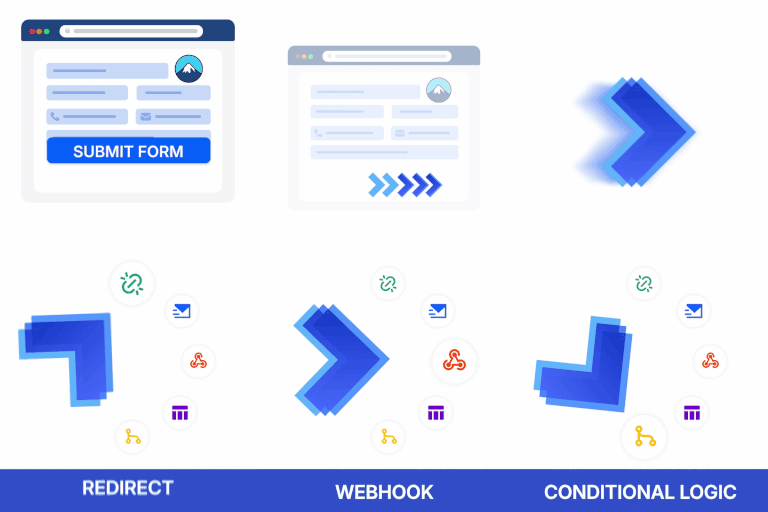
Redirection for Contact Form 7 enhances your forms with essential post-submission actions all in one plugin. Store form entries in your database, redirect users to any page or URL, send email notifications, block spam with honeypot protection, and help with GDPR compliance through data export/erase requests. Want more power? Our PRO version includes JavaScript execution after submission, webhook integration for third-party services, conditional logic based on user input, frontend post creation, PDF generation from form data, and seamless integrations with popular services like Mailchimp, PayPal, Stripe, HubSpot, Salesforce, and Twilio. 🔗 HELPFUL LINKS: Need any help with setup? CHECK DOCUMENTATION Interested in Redirection For CF7 Pro? LEARN MORE USAGE Simply go to your form settings, select the “Action” tab, and add additional Submission Actions based on your requirements. NOTE: This plugin requires CF7 version 4.8 or later. 🤝 HOW REDIRECTION FOR CF7 CAN HELP YOU: Redirect to Any URL: Easily redirect users to any specific webpage after form submission, enhancing user navigation and experience. Open Page in a New Tab: Configure forms to open the target URL in a new tab, keeping your site accessible to users post-submission. Pass Fields from the Form as URL Query Parameters: Seamlessly append submitted form data to the URL as query parameters, enabling personalized follow-up pages. Add Honeypot to Minimize Spam: Integrate a honeypot technique in your forms to prevent spam without affecting user experience. Save Form Submissions to Your Database: Automatically store all form submissions in your database, ensuring no data loss and facilitating easy back-referencing. GDPR Compliance – Create Erase Personal Data Request: Allow users to initiate requests for erasing their personal data, ensuring compliance with GDPR mandates. GDPR Compliance – Create Export Personal Data Request: Enable users to request exports of their personal data, supporting transparency and adherence to GDPR guidelines. 🤩 GET MORE FEATURES WITH REDIRECTION FOR CF7 PRO Add Conditional Logic: Enhance your submission actions with the Conditional Logic of Actions Extension. Set If/Or rules based on user inputs to manage powerful conditional rules effectively. Run JavaScript After Form Submission: Execute custom JavaScript code after a form is submitted, ideal for tracking conversions and integrating with analytics tools. Create and Send PDF: Add the option to generate and send PDF using the submitted form fields. Frontend Publishing: Add the ability to allow your users to publish posts from your website front-end. Webhook Integration: Supercharge your forms with advanced Webhook support—seamlessly connect to third-party apps using POST, GET, DELETE, and PATCH methods, with full compatibility for PARAMS, JSON, and XML formats.Empower your forms with advanced Webhook integration, supporting POST, GET, DELETE, PATCH methods and PARAMS, JSON, and XML formats for comprehensive connectivity with third party apps. Add a Thank You Popup: Add the ability to thank your users with a noticeably designed thank-you popup. Integrate with Mailchimp: Add the ability to register submitted forms to any of your MailChimp lists. Integrate PayPal & Stripe: Collect payments from your users by redirecting them to PayPal or Stripe. Integrate with HubSpot CRM: Add the ability to send form submissions from Contact Form 7 to HubSpot CRM. Integrate with Salesforce CRM: Add the ability to send submission forms from Contact Form 7 to Salesforce CRM. SMS with Twilio Integration: Add the ability to send SMS messages to your users or notifications to yourself using Twilio. Unlock these premium features and more with Redirection for CF7 PRO! Still have questions? Ask your pre-sales questions here, and we will get back to you promptly. Or, purchase with confidence and try it for yourself—we offer a 30-day no-questions-asked 100% money-back guarantee. 🤔 WHAT YOU CAN DO WITH REDIRECTION FOR CF7: Redirection for Contact Form 7 opens up a world of opportunities! Explore how different audiences can leverage its features: 📦 E-commerce Sites: Automate order confirmations and updates through SMS with the Twilio integration, providing customers with real-time updates directly on their phones. 🫶 Non-Profit Organizations: Enhance donor engagement by redirecting donors to personalized thank you pages using Conditional Logic, and manage GDPR compliance with data export and erase requests. 🏠 Real Estate Agencies: Direct potential clients to a customized URL after form submission, showcasing specific property details or offers based on the input from inquiry forms. 🛠️ Tech Support Services: Link form submissions with Salesforce or HubSpot CRM to automatically create support tickets and manage follow-up actions efficiently. 📚 Education Providers: Implement the Frontend Publishing feature to allow students to submit assignments and projects directly through forms, making submission processes smoother and more organized. 📈 Marketing Teams: Capture lead information and automatically add it to a Mailchimp email list for subsequent marketing campaigns, ensuring seamless integration with your digital marketing strategies. 💵 Freelancers and Consultants: Offer a streamlined payment process by integrating with PayPal and Stripe, allowing clients to pay for services directly through the submission form. 📝 Bloggers and Influencers: Manage user-generated content by enabling frontend post submissions, allowing followers to contribute stories, photos, or feedback directly on the website. ✨ YOU SHOULD USE REDIRECTION WITH CF7 IF: You Want to Personalize User Journeys: Provide a tailored experience by redirecting users to pages that fit their needs. You Aim to Automate Processes: Simplify workflows by directing users to relevant resources or actions after form submission. You Seek to Increase Engagement: Capture user interest by guiding them to content or offers that resonate with them. You Need to Optimize Conversions: Redirect users to strategically designed pages to maximize conversion opportunities. You Plan to Manage Leads Efficiently: Ensure leads are channeled to the right destination for effective handling and follow-up. 👋 WE’RE HERE FOR YOU, AND WE TAKE ALL FEEDBACK SERIOUSLY 📚 Knowledge Base: We’ve created a complete documentation library and we’re still constantly updating with new tutorials. 🦸 Support forum: We’re here to help. Feel free to open a new thread on the Support Forum. 🎙️ SEE WHAT REAL USERS TALK ABOUT US Very nice and helpful plugin – “This is a very helpful plugin. It makes my task much easier and it is also very nice for website users to be redirected to the summary page of their entries.” Works like a charm 🙂 – “What else to say? When a customer submits a form, it fluently redirects him/her to specific url when I say “Thank you for submitting the form, we will contact you later…”. So thank you very much creators!” 5 star – “Working with Conversion tracking and I like the fact that you can pull the contact form fields in that you want to show on the Thank you page. Everything works fantatic.” Really useful! – “Just chiming in with a positive review. Works great, and has been for a while now. Thanks so much!!”